| Case name: | Bayley v The Manchester, Sheffield, and Lincolnshire Railway Company (1873) LR 8 CP 148 |
| Legal action: | Negligence and Assault |
| Incident date: | |
| Jurisdiction: | Manchester, England |
This post tells the story of a blundering nineteenth-century railway porter who mistakenly pulled a passenger from a moving train, causing serious injury. Behind these dramatic facts lies a question that is central to the legal doctrine of vicarious liability: under what circumstances will an employee’s mistaken or wrongful act fall within the course of employment, such that their employer may be held liable?
A Blundering Porter on the Manchester, Sheffield and Lincolnshire Railway
In the summer of 1871, Mr Bayley was a passenger on the defendant’s railway line. Formed in 1847, the Manchester, Sheffield and Lincolnshire Railway (MS&LR) served largely as a feeder network, channelling trains into England’s main railway lines. In addition to its railway interests, the MS&LR was one of the largest canal-owning companies in the United Kingdom. The carriages on its trains were known for being ‘exceedingly well equipped’, with even the third-class carriages ‘well cushioned and roomy, with a larger amount of window space than usual’.1 It was a third-class carriage in which Mr Bayley was travelling on the day of the incident.
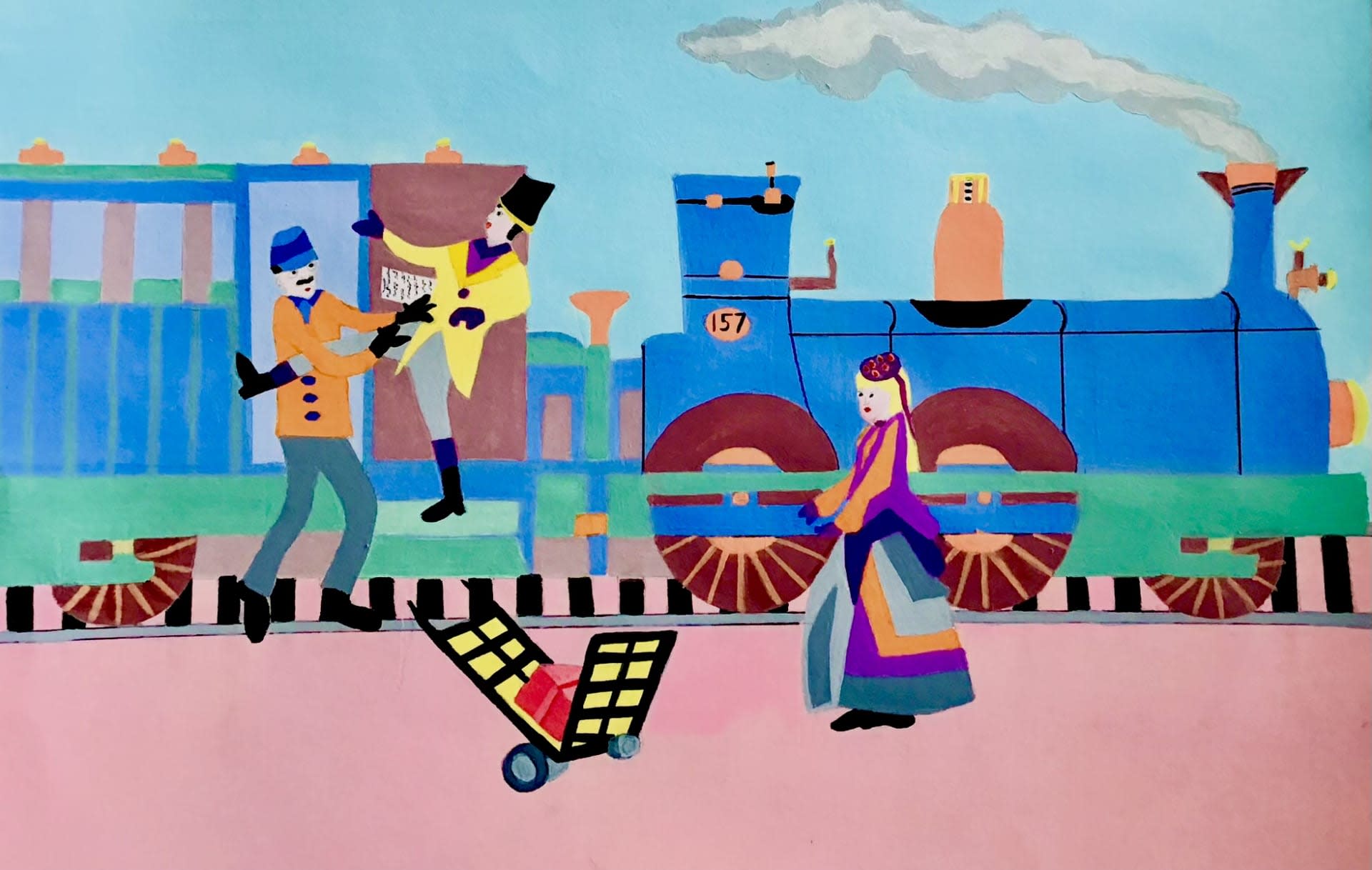
Having purchased a ticket for what he believed to be the correct train, Mr Bayley boarded at Guide Bridge Station in Greater Manchester. Shortly before departure, a station porter employed by the railway company asked him where he was travelling. Mr Bayley replied, “To Woodley, and thence to Stockport and Macclesfield”. Alarmed, the porter told him that he had boarded the incorrect train and urged him to alight. When Mr Bayley hesitated and the train began to move, the porter violently pulled him from the carriage, causing both men to fall hard onto the platform. Mr Bayley was seriously injured. He had, in fact, boarded the correct train.
Mr Bayley sued the railway company in negligence and assault, seeking compensation for his injuries. The company contended that the porter had no authority to drag Mr Bayley out of the carriage. On that basis, it argued that the porter’s conduct fell outside the scope of his employment, meaning the railway company should not be held vicariously liable for his actions.
Vicarious Liability: A Brief Overview
Vicarious liability is a rule of legal responsibility under which one person may be held liable for a tort committed by another. On the traditional (though contested) view, vicarious liability entails duplicating the tortfeasor’s liability (but not wrongdoing) onto the defendant; the defendant is not themselves regarded as a wrongdoer.2 Vicarious liability thus presents the plaintiff with two potential defendants: the individual tortfeasor and the third party who is held liable for that person’s actions. The history of vicarious liability can be traced back to Roman law, which recognised the liability of a superior for the wrongful acts of their inferiors.3 The head of a family could be held liable for the delicts (torts) of his child or slave, and was required to either pay damages on their behalf or to hand the child or slave over to the injured party (the doctrine of ‘noxal surrender’).4
The quintessential example of vicarious liability is an employer’s liability for torts committed by their employees in the course of employment, regardless of the employer’s own fault. As a form of strict liability, an employer may be held responsible for an employee’s negligence, even if the employer has themselves exercised due care. The doctrine gained particular significance during the Industrial Revolution, when the rapid expansion of industrial activity and growing workforces heightened the risk of employees causing harm to others.5
While not directly addressed in other posts on this website, vicarious liability has been a central feature in many of the railway-related torts cases discussed, where the negligence of an individual worker gives rise to liability for the railway company or public transport agency that employs them. To take just one example, readers will recall that in Public Transport Commission (NSW) v Perry,6 a train driver failed to stop a train upon seeing an object on the tracks, mistakenly believing it to be a large piece of paper rather than a woman who had fallen after an epileptic fit. However, the defendant was not the train driver himself, but his employer, the Public Transport Commission of NSW, which it was accepted was vicariously responsible for the driver’s breach of duty.
While the High Court of Australia has observed that a ‘fully satisfactory rationale for the imposition of vicarious liability’ has been ‘slow to appear in the case law’,7 various justifications and policy reasons have nonetheless been proffered for allowing plaintiffs to bring an action against the tortfeasor’s employer.8 These include:
- A loss-distribution rationale: this emphasises the desirability of providing a solvent defendant. Individual employees are often unlikely to be worth suing, especially when compared to the employer who typically has ‘deep pockets’ and, in many cases, insurance coverage.
- An enterprise liability justification: the idea that those who create a risk by operating an enterprise should bear a significant share of that risk.
- A deterrence rationale: this views vicarious liability as encouraging employers to implement proper safety standards within the enterprise, including through suitable training and supervision and careful employee selection.
It should be noted, however, that an employer’s careful selection of staff is no defence to vicarious liability.9 As explained by Posner:
‘A careless workman is like a defective machine. A company should devote resources to screening out careless workmen just as it should devote resources to inspecting its machinery for defects’. The issue of course, is that in relation to defective machinery, a company will be liable ‘only for those defects that a reasonable inspection would have discovered. But the law seemingly takes an inconsistent position with respect to the careless workman. The employer is liable regardless of his care in attempting to prevent carelessness.’10
Posner’s explanation highlights why the doctrine of vicarious liability is viewed as problematic by many scholars. As Giliker observes, while vicarious liability ‘lies at the heart of all common law systems of tort law’, it is ‘at odds with tort’s traditional focus on general principles of individual responsibility’.11 Tort law is commonly understood as a mechanism of corrective justice. Aristotle presented corrective justice as an equality between two parties in a bilateral transaction, with injustice arising when one party realises a gain at the expense of the other, creating a disturbance of equality.12 The law remedies this injustice by restoring the initial balance, depriving one party of the gain and returning it to the other.13 Herein lies the tension with vicarious liability. Typically, responsibility is ascribed to a defendant who causally contributed to the harm suffered by the plaintiff. However, in the case of vicarious liability, the party held responsible is not the one who ‘did it’.14 As Weinrib explains, ‘corrective justice is the normative relationship of sufferer and doer’, meaning vicarious liability only aligns with corrective justice ‘if the employer can, in some sense, be regarded as a doer of the harm’.15 This is one reason why the law of vicarious liability requires an employee’s fault to be so closely connected to their employment that responsibility can be imputed to the employer.
In Australia, several High Court judges held in New South Wales v Lepore that an employee’s conduct will fall within the scope of employment only if it is sufficiently connected with their duties.16 This test was later reframed to focus on whether employment gave rise to the ‘occasion’ for the employee’s wrongful act, rather than the mere ‘opportunity’.17 More recently, in a case involving two co-workers sharing staff accommodation, the High Court has returned to the language of ‘connection’.18 In that case, a drunken employee accidentally urinated on his sleeping co-worker, who suffered a cataplectic attack and later developed PTSD.19 A majority of the Court observed that the connection between the tortious conduct and employment was too tenuous; performance of the worker’s duties had not provided the occasion for the tort. As such, the employer could not be held vicariously liable for the urination event.20
Where an employee is acting upon a ‘frolic’ of his or her own, the conduct is treated as the personal responsibility of the employee. Many cases have examined the question of legal responsibility for incidents of physical violence perpetrated by employees. In Deatons Pty Ltd v Flew,21 a barmaid named Opal Ruby Pearl Barlow threw a glass of beer at a drunken customer who had insulted her. The glass, having also slipped from her hand, struck him hard on the face. The Court held that the barmaid was not acting in the course of her employment. This was an independent act of passion, not intended to further her employer’s interests. By contrast, in a series of ‘bouncer cases’, employers have generally been held vicariously liable when their security guards have physically attacked patrons. Often, the behaviour of these guards, although clearly unauthorised and inappropriate, is viewed as sufficiently connected to their duties.22 The principle here is that if an employee is carrying out their duties (or something incidental to their duties), the employer can be liable, even if those duties are carried out in a wrongful or unauthorised manner. So what about the conduct of a railway station porter who forcefully ejects a passenger from a moving train? Could such an act be considered a wrongful mode of performing his duties, for which his employer might be held responsible?
The Porter’s Dilemma: When Railway Rules Collide
Let us return to 1871 and the case of Mr Bayley and the overzealous porter. The railway company which employed the porter had a series of rules and by-laws that porters were expected to follow. Unfortunately, some of these rules appeared to conflict. On the one hand, the rules instructed porters to prevent passengers from entering or alighting from moving trains. This would, of course, suggest that pulling Mr Bayley from a moving train was inconsistent with the porter’s duties. On the other hand, porters were also charged with preventing passengers from travelling without a valid ticket, which could arguably justify the porter’s attempt to remove Mr Bayley, based on his (mistaken) belief that he had boarded the incorrect train. Yet there was no express rule directing porters to remove passengers who were travelling on the wrong train. By contrast, the rules specifically stated that passengers who were smoking, intoxicated, or creating a nuisance were to be removed.
The Court Decides
At the trial before Channell B in the Chester Assizes, the porter sought to exculpate his employer, stating that he had no authority to throw a passenger from a moving train. The jury, however, disagreed, finding against the railway company and awarding Mr Bayley £200. Following the verdict, the railway company moved to enter a nonsuit on the basis that it could not be held responsible for the porter’s wilful and unauthorised act.
In the Court of Common Pleas, it was held that there was sufficient evidence upon which the jury could find that the porter’s act was done in the course of his employment, meaning the company was vicariously liable for his actions.23 The Court’s judgment was delivered by Willes J. His Honour found that the duty in the by-laws to prevent passengers from travelling without a valid ticket impliedly gave porters a power to remove any such passengers. According to Willes J:
‘A person who puts another in his place to do a class of acts in his absence, necessarily leaves him to determine, according to the circumstances that arise, when an act of that class is to be done, and trusts him for the manner in which it is done; and consequently he is held answerable for the wrong of the person so intrusted either in the manner of doing such an act, or in doing such an act under circumstances in which it ought not to have been done; provided that what was done was done, not from any caprice of the servant, but in the course of the employment.’24
The defendant appealed against the Court’s judgment and Mr Bayley’s case came before the Exchequer Chamber.25 While counsel for the railway company conceded that Mr Bayley would have been acting in the course of his employment if he had improperly performed his duties, it was contended that it was no part of a porter’s duty to remove persons who might be on the wrong train. An act expressly forbidden by the company’s instructions (alighting from a moving train) could not fall within the scope of the porter’s authority.
One of cases cited by the defendant in support of its argument was Poulton v The London and South Western Railway Company.26 In that case, a station master arrested a man who was transporting a horse by rail on suspicion that he had not paid the carriage fee. However, the company had authorised the station master to arrest passengers for fare evasion only, not for failure to pay for the carriage of goods such as horses. Accordingly, the court found that the station master’s act fell outside the scope of his authority and the railway company was therefore not liable. Mellor J observed that, had the station master merely made a mistake in the execution of an act he was authorised to perform, the company would have been liable; but here, the act itself was unauthorised.27
For the judges in the Exchequer Chamber, however, Mr Bayley’s case was materially different, with the porter’s forceful removal of Mr Bayley not equivalent to the arrest carried out by the station master in Poulton. Kelly CB reasoned that the railway company’s rules imposed overlapping and inconsistent duties upon the porter, such that literal compliance with all of them was not always possible. Where these duties conflicted, it was likely that an employee acting to fulfill a general duty (namely, to prevent persons from travelling on the wrong train or without a valid ticket), might neglect a particular instruction as to the mode of doing so (namely, the prohibition against passengers entering or leaving moving trains and the duty on porters to prevent this). In these circumstances, the employee’s actions would still fall within the scope of their employment. The porter reasonably believed that he was acting in the company’s interests, even if he had misjudged the situation. Blackburn J was of the same view, observing that the porter’s conduct, though ‘stupid’ and ‘blundering’, was still a performance—albeit an inept one—of his assigned duties.28 The remaining judges (Martin B, Cleasby B, Mellor J, Lush J and Pigott B) also agreed, though Pigott B cautioned that the case was ‘one that is very near the line’.29
Authorised Acts, Unauthorised Means: The Reach of Vicarious Liability
In Mr Bayley’s case, the railway company was held vicariously liable for its porter’s violent ejection of a passenger from a moving train. The decision underscores that vicarious liability can attach to acts done in a mistaken or wrongful manner while attempting to further the employer’s interests. As Blackburn J’s judgment recognises, employers who benefit from conferring discretion on their employees must also bear the risks of their misjudgments. In line with the deterrence rationale for vicarious liability discussed earlier, Blackburn J noted that if railway companies employ porters whose duties require exercising judgment under pressure, including when dealing with passengers, then they must ensure those porters are ‘steady, trustworthy, and intelligent persons’, or accept liability when they are not.30
A number of subsequent decisions have cited Mr Bayley’s case, including the factually similar Stevenson v Glasgow Corporation.31 In that case, the plaintiff, a passenger on a tram in 1921, was forcibly ejected by the conductor while the tram was in motion. With her husband’s consent, she brought an action for damages for personal injuries, alleging that the conductor had asked her to leave the tram due to overcrowding, but pulled her off before she could alight. She sustained serious injuries as a result of falling backwards out of the tram and onto the road, including spinal injury and nervous shock. After the accident, she was unable to attend to her household duties. The defendant company argued that they were not liable for the conductor’s actions which constituted a serious assault outside the scope of his employment. However, the Court rejected this argument and remitted the case for trial by jury. The conductor had been performing his duty of regulating passengers and preventing overcrowding on trams. Although he acted with excessive zeal and caused injury, as in Bayley, this did not necessarily take his conduct outside the course of employment so as to absolve the company of liability.
Mr Bayley’s case was most recently cited in the 2022 case of Garrett v Victorian Workcover Authority, in support of the proposition that an employer may be vicariously liable where an employee performs an authorised act in an unauthorised manner.32 However, unlike in Bayley, the employer in Garrett was not held responsible. The foolish conduct of a bored security guard in pointing his gun at a colleague’s head was not a ‘natural extension’ of his duties, and the facts were distinguishable from other cases in which employers have been held vicariously liable for the actions of workers who perform their duties with excessive zeal or force.33
Mr Bayley’s action against the Manchester, Sheffield, and Lincolnshire Railway Company stands as an early example of how an employer may be held liable for an employee’s wrongful and misguided attempt to further the company’s interests. This post has focused on the second limb of vicarious liability—whether the employee’s conduct occurs in the course of employment. That inquiry, however, is preceded by an increasingly contested threshold question: whether the relationship is properly characterised as one of employer and employee, or whether liability may attach across a wider range of relationships, including those ‘akin to employment’.34 In recent years, this issue has generated significant judicial and academic debate.35 While nineteenth-century railway cases such as Bayley helped shape the law of vicarious liability, the doctrine continues to be tested by new forms of work and emerging sources of risk.36
-
J Peabody Pattinson, British Railways: Their Passenger Service, Rolling Stock, Locomotives, Gradients, and Express Speeds (Cassell, 1893). ↩︎
-
In contrast to this traditional view, the competing analysis understands vicarious liability as instead imputing the tortfeasor’s acts to the defendant, who therefore also becomes a wrongdoer: see James Goudkamp, ‘Vicarious liability in Australia: on the move?’ (2017) 17(1) Oxford University Commonwealth Law Journal 162, 169. ↩︎
-
Paula Giliker, Vicarious Liability in Tort: A Comparative Perspective (Cambridge University Press, 2010) 6–7. ↩︎
-
Ibid. It should be noted that today, under Australian law, parents cannot be held vicariously liable for the torts of their children: Smith v Leurs (1945) 70 CLR 256. ↩︎
-
Neil Foster and Jacqueline Meredith, Workplace Health and Safety Law in Australia (3rd ed, LexisNexis, 2024) 184. ↩︎
-
(1977) 137 CLR 107. ↩︎
-
Hollis v Vabu (2001) 207 CLR 21, [35]. See also New South Wales v Lepore (2003) 212 CLR 511, [196]; Prince Alfred College Incorporated v ADC (2016) 258 CLR 13, [39]. ↩︎
-
See New South Wales v Lepore (2003) 212 CLR 511, [197] ff. For further discussion of the justifications for vicarious liability see Paula Giliker, ‘Vicarious Liability in the Common Law World: An Introduction’, in Paula Giliker (ed), Vicarious Liability in the Common Law World (Hart Publishing, 2022) 1. ↩︎
-
Accordingly, scholars recognise that deterrence cannot be a complete explanation for the imposition of vicarious liability: see Frederick Pollock, Essays in Jurisprudence and Ethics (Kessinger Publishing, 1882). ↩︎
-
Richard A Posner, ‘A Theory of Negligence’ (1972) 1 Journal of Legal Studies 29, 42. ↩︎
-
Giliker (n 3) 1. ↩︎
-
See Ernest J Weinrib, ‘Corrective Justice in a Nutshell’ (2002) 52(4) The University of Toronto Law Journal 349, 349–351. ↩︎
-
Of course, it will often not be possible to literally restore the initial balance. If the breach of tort law duty results in the amputation of the plaintiff’s leg, the law cannot replace that limb. However, tort law seeks to place the plaintiff, as far as possible, in the position they were in before the tort was committed, through monetary compensation. ↩︎
-
Daniela Glavaničová and Matteo Pascucci, ‘Making Sense of Vicarious Responsibility: Moral Philosophy Meets Legal Theory’ (2022) 89 Erkenntnis 107, 110. ↩︎
-
Ernest J Weinrib, The Idea of Private Law (Oxford University Press, 2012) 186. ↩︎
-
New South Wales v Lepore (2003) 212 CLR 511, [273], [320] (Kirby J); [40], [74] (Gleeson CJ). See also [166] (McHugh J). ↩︎
-
Prince Alfred College Incorporated v ADC (2016) 258 CLR 13, [80]. ↩︎
-
CCIG Investments Pty Ltd v Schokman (2023) 278 CLR 165. ↩︎
-
A cataplectic attack is a ‘sudden and ordinarily brief loss of voluntary muscle tone which is triggered by emotional stress’: CCIG Investments Pty Ltd v Schokman (2023) 278 CLR 165, [6]. ↩︎
-
CCIG Investments Pty Ltd v Schokman (2023) 278 CLR 165, [33]–[37]. ↩︎
-
(1949) 79 CLR 370. ↩︎
-
See, eg, Starks v RSM Security Pty Ltd [2004] NSWCA 351; Ryan v Ann St Holdings Pty Ltd [2006] QCA 217; Sprod bnf Sprod v Public Relations Oriented Security Pty Ltd [2007] NSWCA 319. ↩︎
-
Bayley v The Manchester, Sheffield, and Lincolnshire Railway Company (1872) LR 7 CP 415. ↩︎
-
Ibid 420. ↩︎
-
Bayley v The Manchester, Sheffield, and Lincolnshire Railway Company (1873) LR 8 CP 148 (‘Bayley’). ↩︎
-
(1866 –67) LR 2 QB 534. ↩︎
-
Ibid 540–41. ↩︎
-
Bayley (n 25) 155. ↩︎
-
Ibid 155. ↩︎
-
Ibid. ↩︎
-
[1922] ScotLR 189. ↩︎
-
[2022] VSC 623, [91]. ↩︎
-
Ibid [147]. The decision was upheld by the Court of Appeal in Garrett v Victorian Workcover Authority [2023] VSCA 144. ↩︎
-
In Australia, see Bird v DP (2024) 419 ALR 552. ↩︎
-
A key impetus for this debate has been the desire to reshape the law of vicarious liability in order to provide a remedy to victims of child sexual abuse in institutional settings, by enabling churches to be held liable for sexual assaults committed by priests or ministers whose relationship with the church is spiritual rather than one of formal employment. ↩︎
-
One emerging area is the proposed use of vicarious liability as a mechanism for regulating employers’ responsibility to third parties for harm caused by their ‘AI workers’: see, Iwona Gredka-Ligarska, ‘Vicarious Liability for Damage Caused by an AI Worker: Comparative Law Perspective’ (2025) 21(1) Utrecht Law Review 36. ↩︎